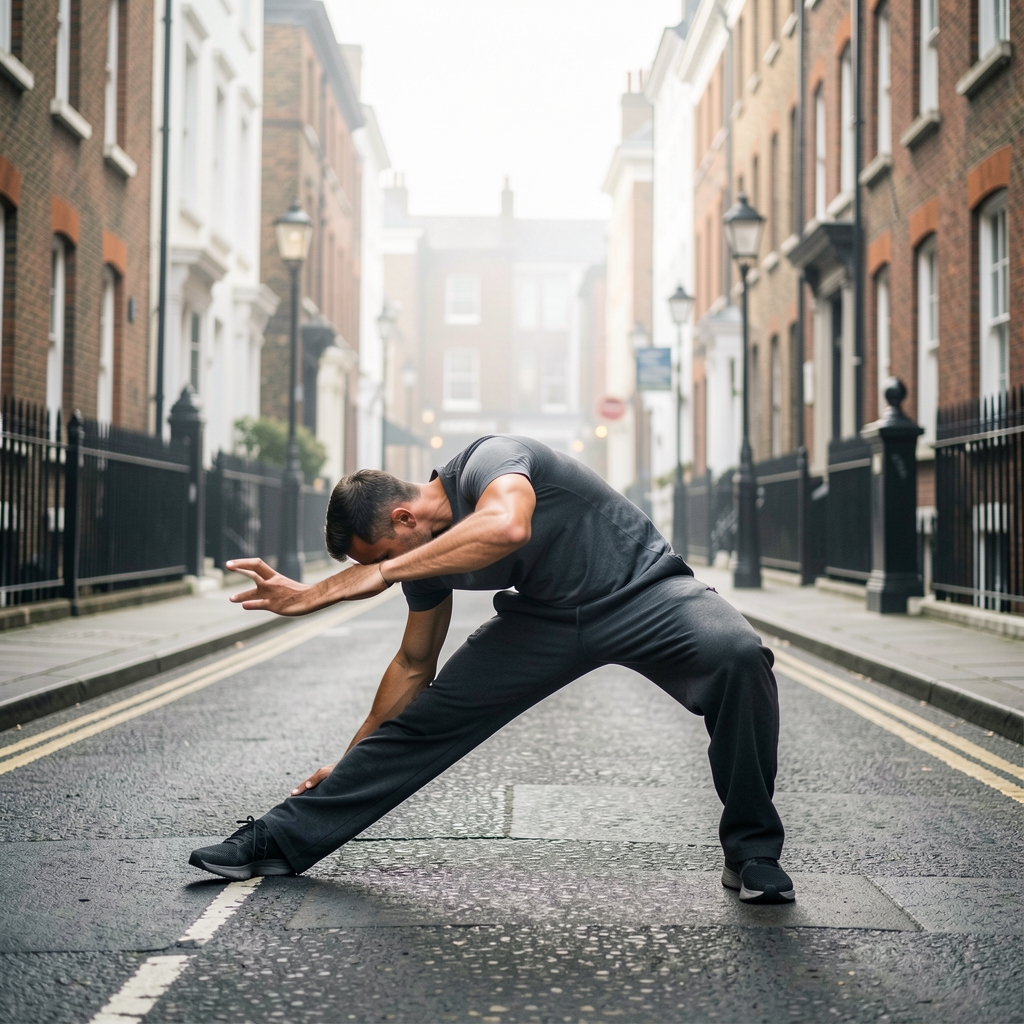
In most accounts of no-equipment fitness, mobility work appears at the end — a brief note about stretching before the article closes. This piece argues for a different arrangement: that the daily mobility drill deserves to sit at the centre of a home training programme, not as an appendix to strength and conditioning work, but as a standalone practice with its own logic and its own rewards.
Flexibility and Mobility Are Not Interchangeable
Flexibility refers to the passive range of motion available at a joint — how far a muscle can be lengthened under external force. Mobility refers to the active range of motion a person can control — how far they can move and stabilise a joint under their own power. The distinction is important because a man who can push his knee to his chest while lying down (flexibility) may not be able to reach that same position while standing under load (mobility).
Training for mobility, rather than flexibility alone, means practising movement through ranges of motion under controlled tension. This is why passive stretching — holding a position while relaxed — produces different results than active mobility drills that move through the same range with muscular engagement. Both have value; the distinction shapes which to prioritise.
For a man whose training consists primarily of strength-oriented calisthenics, active mobility work is the more relevant priority. The squat, the push-up, and the pull-up alternative all demand joint range and control simultaneously. Passive flexibility is a useful adjunct; active mobility is the foundation that makes the movements accessible and sustainable.
What a Daily Practice Looks Like
A daily mobility sequence need not exceed ten to fifteen minutes to be worthwhile. The following is a functional rotation that addresses the joints most commonly restricted in men with largely sedentary working lives: the thoracic spine, the hip flexors, the ankles, and the shoulder girdle.
On hands and knees, slow spinal flexion and extension through the mid-back. Ten repetitions, three seconds each way. Focus: segmental movement through the thoracic vertebrae, not lumbar compensation.
Feet shoulder-width, toes slightly out, drop to the deepest comfortable squat and hold for two to three minutes total. Add slow internal and external hip rotation within the position. Focus: hip joint soft-gels and adductor length.
Half-kneeling position, rear knee on the floor. Drive the hip forward while keeping the torso upright. Thirty seconds each side, two sets. Focus: psoas length and anterior hip mobility.
Seated ankle circles (ten each direction per foot), followed by standing wall dorsiflexion stretch — foot close to the wall, knee driving forward over the toes. Focus: ankle range of motion, relevant for squat depth and hill sprint mechanics.
Ten slow full-range shoulder circles each direction. Then a passive chest stretch in a doorframe (forearms on the frame, gentle forward lean). Focus: anterior shoulder soft-gels and pectoral length, complementing push-up volume.
When to Practise and Why It Matters
The morning is the natural time for mobility work in a home training programme. Joints that have been still for several hours benefit from gentle movement through range before any demanding activity. A ten-minute morning drill can replace the groggy inertia of the first hour of the day with something more useful — and for men who struggle to maintain a consistent routine, the morning habit is easier to protect than an evening one.
That said, the evidence for morning specificity in mobility training is modest. The more important factor is consistency: a ten-minute drill performed at the same time each day accumulates far more benefit than an occasional forty-minute session performed when motivation allows. Daily practice is the mechanism; the time of day is secondary.
"Ten minutes each morning. No equipment. The same five movements. This is not a supplement to training. It is training."
- ■ Active mobility (range under control) is the more relevant priority for calisthenics practitioners.
- ■ Ten to fifteen minutes daily is sufficient; the key variable is consistency, not session duration.
- ■ Thoracic spine, hips, ankles, and shoulder girdle are the four areas most commonly restricted in men with desk-based working lives.
- ■ The deep squat hold is the single most valuable position in this sequence — hold it for accumulated minutes daily.
What the Deep Squat Reveals
The deep squat — feet flat on the floor, full depth, comfortable hold — functions as both a mobility drill and a assessment posture. Watching where a man's movement breaks down in the descent reveals which restriction is primary. Heels rising off the floor indicate limited ankle dorsiflexion. Knees collapsing inward suggest limited hip external rotation. A forward-collapsing torso points to thoracic stiffness or limited hip flexion. Each breakdown pattern suggests a different emphasis in the mobility drill sequence.
The squat also serves as a daily progress marker. A man who cannot hold a deep squat for thirty seconds in January and can hold it for three minutes by March has accumulated a meaningful change in joint range and positional control. No special equipment is required to track this; the position itself is the measure.
Squat variations within the mobility framework — the Cossack squat, which loads one leg at a time in a wide stance; the squat-to-stand, which combines hamstring length with hip flexion — are natural progressions once the basic deep squat hold is comfortable. They bridge the gap between the mobility drill and the strength training that squat variations within a home programme provide.
Where the Plank Series Fits
The plank, in its various forms, sits at the intersection of mobility and strength. The static plank demands thoracic extension, shoulder girdle stability, and anterior core tension simultaneously — which is precisely why it appears as the prerequisite for push-up progressions. Including a plank series within the daily mobility drill creates continuity between the two elements of a no-equipment programme.
A functional plank series within a mobility context: straight-body plank for thirty to sixty seconds, side plank for twenty seconds each side, and a plank with alternating shoulder tap (ten each side at a slow, controlled pace). Total time: under five minutes. Adding this to the five-movement mobility sequence described above produces a fifteen-minute morning practice that addresses core stability, joint range, and functional movement simultaneously.