There is a form of cardiovascular work that combines the brevity of interval training with the structural demands of resistance work — and it requires nothing more than a gradient, a pair of shoes, and the willingness to move at full effort. Hill sprints occupy a singular position in the no-equipment outdoor fitness framework: they are both a conditioning tool and a strength stimulus, enacted by the simple act of running upward.
What Incline Does to the Running Stride
Running on flat ground is a predominantly anterior-dominant activity. The quads and hip flexors drive the pace; the glutes and hamstrings provide a stabilising force rather than the primary propulsive one. On an incline, this changes. The angle of the body relative to the ground forces a different loading: the glutes become primary movers, the hamstrings assist more actively in hip extension, and the calves manage a greater plantarflexion demand on each stride.
The practical consequence of this mechanical shift is that hill sprints build posterior chain capacity in a way that flat running does not. For a man whose weekly training consists primarily of pushing movements — push-ups, dips, and their variations — the posterior chain (glutes, hamstrings, spinal erectors) can become relatively underdeveloped. Hill sprints address this imbalance without requiring any additional equipment.
The gradient also reduces impact force on each footstrike compared with flat sprinting at equivalent intensity. This makes hill work accessible for men who find flat sprinting uncomfortable on the knees or ankles. The upward angle shortens the effective stride, naturally encouraging a midfoot strike and upright posture.
Gradient, Surface, and Length
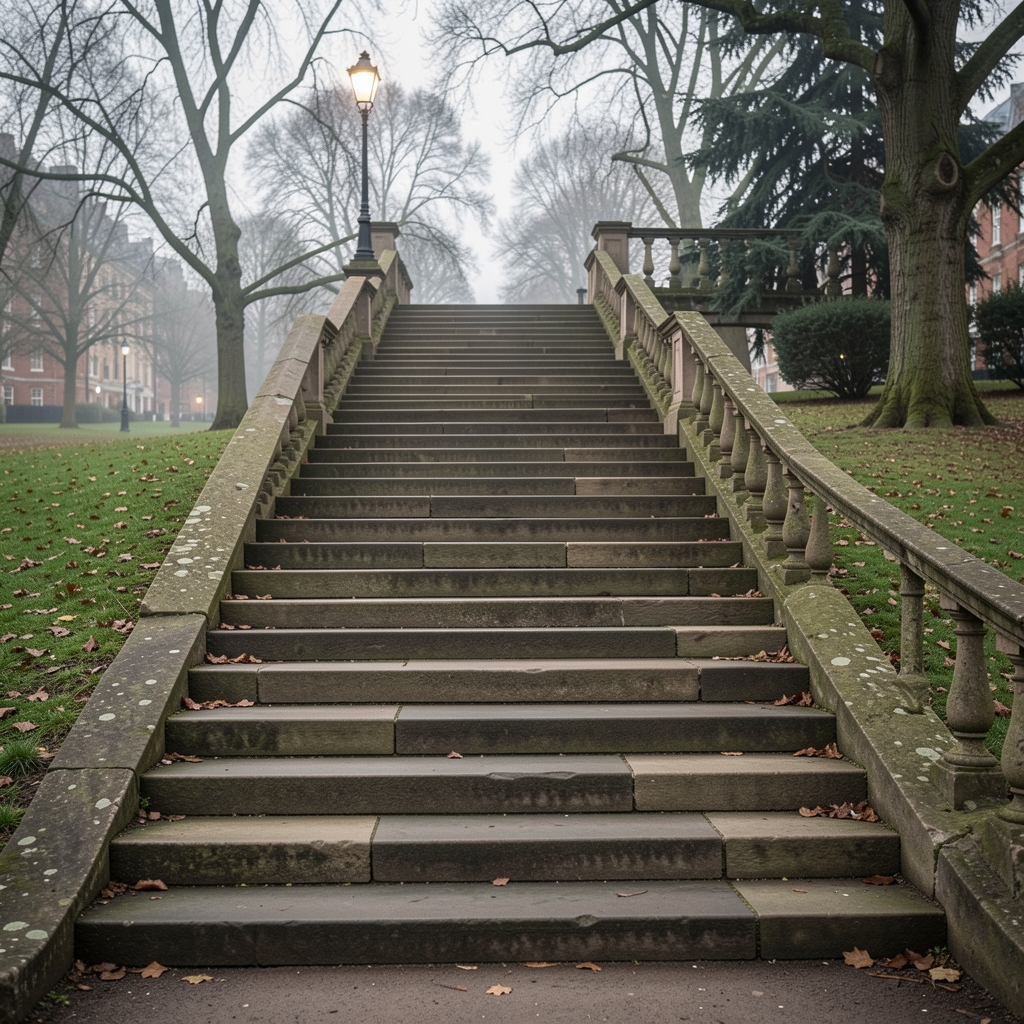
The ideal hill for sprint work has a gradient of roughly eight to fifteen per cent — noticeable but not so steep that running form collapses into a scramble. A flight of outdoor stairs can substitute entirely, and in urban environments like London it often serves better than an actual incline. Stair workouts produce the same posterior chain demand as grass hills and offer the additional benefit of a predictable, consistent surface.
Length matters more than many accounts suggest. A hill or stair run of eight to twelve seconds at full effort is the target duration for peak-intensity sprint work. Below that, there is insufficient time to reach and sustain maximum output. Above twenty seconds, the effort transitions from sprint to tempo run — a different stimulus. Most parks and public stairways in English cities offer something in this range; the challenge is rarely finding the terrain and usually ensuring the effort is genuinely maximal.
Grass surface adds a proprioceptive dimension that tarmac does not. The minor irregularities require continuous ankle stabilisation, engaging the peroneal musculature and tibialis anterior in a way that flat, even surfaces do not. For outdoor fitness routines that cannot include dedicated lower-leg work, this is a meaningful secondary benefit.
"The hill does not require explanation. It requires a full sprint, a long rest, and a willingness to repeat."
How to Build a Hill Sprint Session
The structure of a productive hill sprint session is straightforward: a warm-up, a series of sprints with full recovery between each, and a cool-down walk. What changes week to week is the number of sprints — not the sprint duration, not the gradient, and not the rest period.
A reasonable entry-level session: ten minutes of brisk walking and two to three easy running strides on flat ground, followed by four sprints at full effort with two minutes of walking recovery between each, concluded with ten minutes of easy walking. This is less total work than it sounds. The quality of a four-sprint session executed at genuine maximum effort exceeds that of twelve sprints performed at 70 per cent.
The progression over eight weeks: add one sprint per week until reaching eight sprints per session. At that point, the session can be extended by reducing rest slightly (from two minutes to ninety seconds) rather than by adding further sprints. Quality — defined here as the same gradient completed in the same time or less — is the metric worth tracking, not volume.
- ■ Incline sprinting is a posterior chain stimulus as much as a cardiovascular one.
- ■ Eight to twelve seconds at full effort is the target duration for each sprint.
- ■ Stair workouts in urban environments produce equivalent stimulus to grass hill work.
- ■ Begin with four sprints per session and progress by one sprint per week over eight weeks.
Walking Down Is Part of the Session
The descent between sprints is active recovery, not a gap between sets. A deliberate walk down — taking a full two minutes on a hill of reasonable length — allows the cardiovascular system to return to a level from which the next sprint can be genuine. Jogging down shortens this recovery and consequently reduces the quality of subsequent efforts.
The descent also places an eccentric demand on the quadriceps. On steep gradients, this can produce delayed onset muscle soreness in the days following a session for those unaccustomed to hill work. This is not a reason to avoid descents — it is a reason to begin with fewer sprints and a shallower gradient, allowing the quad connective tissue to adapt over two to four weeks before more volume is added.
On stair workouts, descend by the side railing rather than jumping steps. The risk of ankle inversion on stairs during fatigue is real, and the descending motion is not the productive part of the session.
Where Hill Work Sits in a Weekly Schedule
Hill sprint sessions are demanding enough that two per week is a reasonable ceiling for most men, with at least 48 hours between sessions. Placing them on days following rest or lighter activity (a walking day, a mobility session) allows the posterior chain to perform at its best.
Within a home training programme that includes push-up progressions, plank series, and squat variations, hill sprints provide the element that the other movements do not: high-intensity cardiovascular conditioning and posterior chain loading. A week containing two hill sprint sessions, two to three bodyweight strength sessions, and one or two easy walking days covers most of what a man needs in the way of structured physical activity without any equipment at all.
For those incorporating active commuting — cycling or walking to work — the total daily step count and low-level activity work takes care of base aerobic conditioning. Hill sprints then serve a more targeted role: a twice-weekly stimulus that the rest of the week's activity does not replicate.
Outdoor Fitness Across the English Year
In England, the outdoor fitness routine must account for rain, reduced daylight, and ground conditions that vary substantially between November and March. Hill sprints on wet grass require more care at the plant-and-push phase of each stride; soft ground absorbs energy and can contribute to ankle instability if the approach is careless. Stair-based sessions become preferable in wet conditions, provided the surface has adequate grip.
Early morning sessions in winter offer one practical advantage: fewer people on the hill or stairway, which reduces the social friction of full-effort sprinting in a public space. This is a real consideration for men beginning hill work; the visibility of maximum-effort running can feel uncomfortable in a crowded park. Early morning, particularly in the November-to-February window, resolves this entirely.
The outdoor running plan for winter months is simply a version of the summer plan with: adjusted footwear (trail shoes or shoes with adequate tread), slightly longer warm-up (twelve minutes instead of ten), and a willingness to substitute stairs for grass when the weather makes the latter genuinely hazardous.